
Robin Linus Unveils Native Bitcoin Poker Protocol Reviving Satoshi Nakamoto Early Concept
A new cryptographic breakthrough enables fully decentralized, two-player Texas Hold'em games settled natively on the Bitcoin network without external oracles.
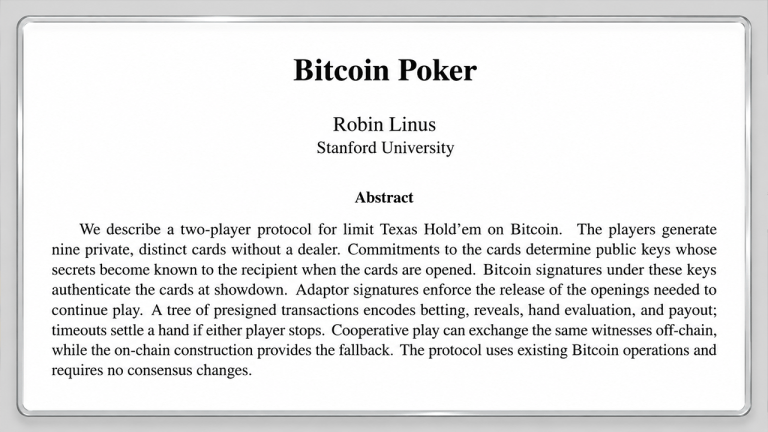
Independent researcher Robin Linus has published a novel cryptographic architecture allowing decentralized card gameplay directly over the blockchain, successfully implementing an uncompleted Bitcoin poker protocol concept initially left in the base codebase by Satoshi Nakamoto. According to reporting from Bitcoin.com News, the new mechanism allows two participants to conduct a game of Texas Hold'em without trusting a central dealer or relying on off-chain coordinator servers.
Under this design, cryptographic primitives handle the blind shuffling and private deal of digital cards between two counterparties. The protocol ensures that neither participant can peek at the opponent's private hand or alter the deck arrangement during dealing phases. Once the hand concludes, winning outcomes and stake distribution execute natively against Bitcoin's fundamental consensus and script verification capabilities without requiring hard forks.
The initiative addresses an ambition dating back to the earliest iterations of Bitcoin's software in 2008 and 2009, where Nakamoto had stubbed out preliminary peer-to-peer card interfaces before stripping the experimental code prior to broad public adoption. For nearly two decades, technical hurdles surrounding fair cryptographic shuffling without centralized parties kept the concept theoretical on the base ledger layer.
While community enthusiasts have celebrated the technical milestone as proof of Bitcoin's computational adaptability, developers note several operational boundaries. The current state machine is restricted to two-player heads-up formats, meaning multi-player tables remain an unsolved efficiency challenge. Furthermore, disputes and deliberate disconnections require specific multi-signature timeout contingencies to protect deposited capital from hostage situations.
Observers are watching to see if developers integrate the design into consumer-facing lightning applications or experimental layer-2 networks. The wider rollout will test whether high-frequency cryptographic state transfers can function smoothly under standard transaction fee environments on the mainnet.
Key takeaways
- Researcher Robin Linus designed a cryptographic protocol enabling decentralized two-player poker on Bitcoin.
- The system realizes an uncompleted feature originally drafted by Satoshi Nakamoto in early Bitcoin client builds.
- Current constraints limit matches to two-player setups while requiring time-locked refund safety rails.